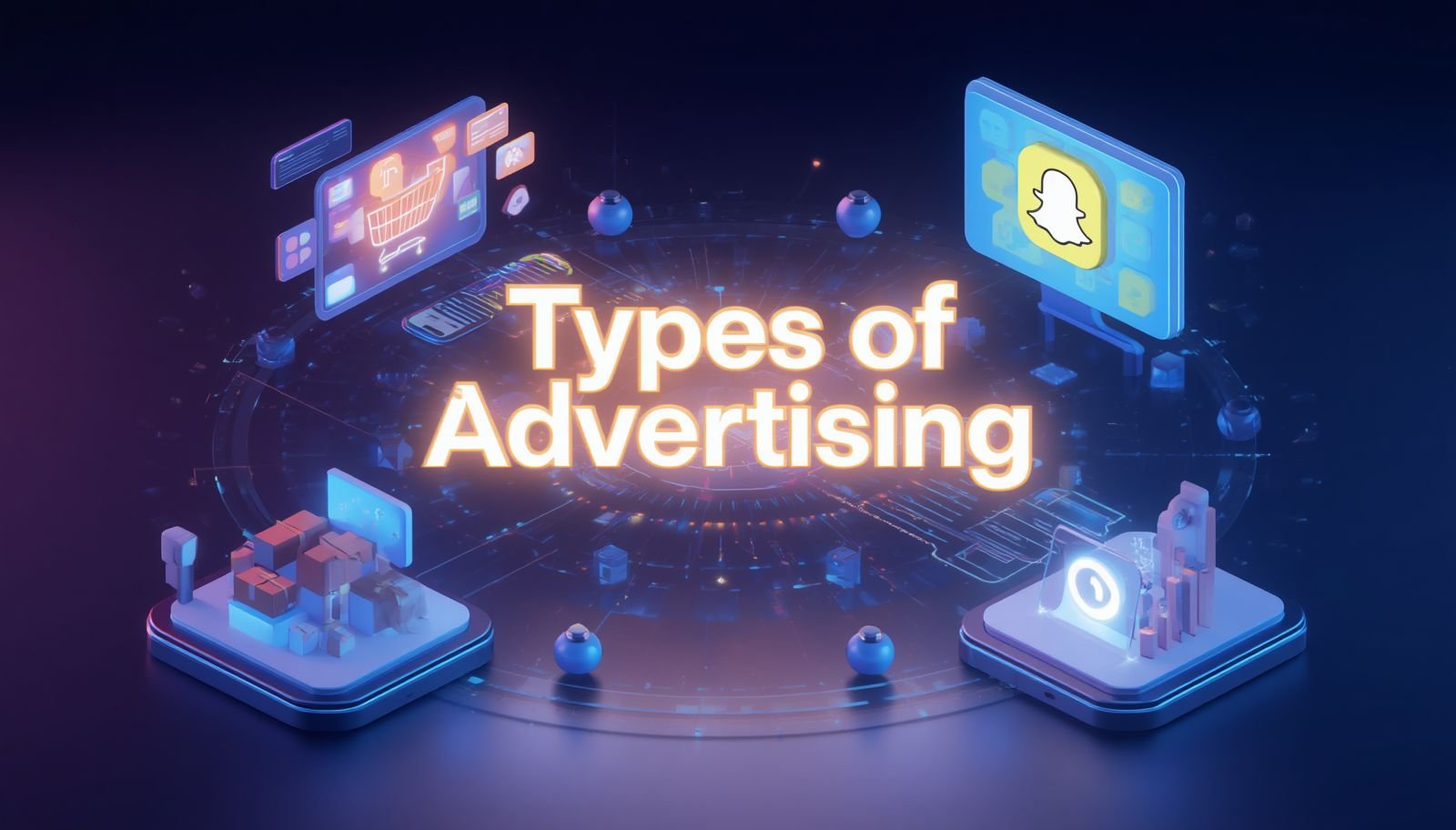
The main types of advertising include digital, social media, Amazon, Snapchat, product, brand, and traditional advertising. Each serves a different purpose—some drive immediate sales, others build long-term recognition. The right choice depends on your goals, audience, and budget.
Every business needs to advertise. But spending money on the wrong channels is one of the fastest ways to burn a marketing budget. Once you understand the different types of advertising available, it becomes much easier to invest with confidence. See full blog on Advertising معنى.
Digital Advertising
Digital advertising covers any paid content delivered online—search engines, websites, apps, and more. Global digital ad spend is projected to hit $740 billion in 2026, growing at 11.4% annually. The appeal is clear: precise targeting, real-time data, and measurable ROI.
Common formats include:
- Pay-per-click (PPC) ads on Google
- Display ads on websites and apps
- Video ads on YouTube
- Programmatic advertising powered by AI
Choose digital advertising when you need scalable reach and the flexibility to adjust campaigns fast.
Amazon Advertising
Amazon advertising helps brands reach shoppers directly on the world’s largest e-commerce platform. Amazon’s ad services generated $17.24 billion in Q1 2026 alone—up 24% year-over-year.
The platform’s strength is purchase intent. People on Amazon are ready to buy, so ads there tend to convert at higher rates than broader display networks.
Key formats include:
- Sponsored Products — appear in search results and on product pages
- Sponsored Brands — highlight your logo and multiple products
- Sponsored Display — retarget shoppers on and off Amazon
Amazon advertising works best for e-commerce brands that want to capture high-intent buyers at the moment they’re ready to purchase.
Snapchat Advertising
Snapchat advertising gives brands access to a massive, engaged younger audience. As of Q1 2026, Snapchat has 483 million daily active users, with a core demographic aged 18–34.
Ads appear between Stories, in Discover content, and as AR Lenses—interactive experiences played over 9 billion times per day.
Top formats include:
- Snap Ads — full-screen vertical video
- Collection Ads — showcase multiple products
- AR Lenses — immersive branded experiences
Choose Snapchat advertising when your audience skews younger and you want creative, visual campaigns over direct-response formats.
Product Advertisement
Product advertisement is all about promoting a specific item—its features, benefits, price, and availability. The goal is simple: drive purchases.
Examples include:
- Google Shopping ads featuring a product image and price
- Amazon Sponsored Products for individual listings
- Direct-response social ads linking to a product page
Product advertising is the right move when you have a clear offer and want to generate immediate conversions. It works best when demand already exists and you just need to capture it.
Brand Advertising
Brand advertising takes a longer view. Instead of pushing a specific product, it builds awareness, shapes perception, and creates emotional connections over time. Think Nike’s “Just Do It” or Apple’s “Think Different”—ads that sell an idea, not just a product.
It’s measured through:
- Brand lift — shifts in awareness or purchase intent
- Share of voice — how much of the conversation you own
- Sentiment — how people feel about your brand
Businesses have improved brand lift by 31% through digital advertising alone. Brand advertising pays off when you’re entering a new market, repositioning a product, or competing for mindshare in a crowded space.
Social Media Advertising
Social media advertising spans Facebook, Instagram, TikTok, LinkedIn, Pinterest, Snapchat, and more. Each platform attracts a different audience:
- Facebook & Instagram — broad reach, strong for awareness and conversions
- LinkedIn — ideal for B2B campaigns targeting by job title or industry
- TikTok — short-form video for Gen Z audiences
- Pinterest — high purchase intent in fashion, home, and food
- Snapchat — immersive visual campaigns for younger users
Mobile ad spending recently hit $327 billion, showing how central social platforms have become. Social media advertising delivers strong ROI when creative matches the platform, targeting is tight, and you’re testing consistently.
Traditional Advertising
Don’t expect traditional advertising, like TV and radio spots, billboard ads, or direct mail, to take a vacation any time soon. It’s expected that TV and video ads worldwide are projected to hit $391.33 billion by 2026!
The strength of traditional advertising is familiarity. A driver may read a billboard, and a TV viewer may catch an ad, but both occurred passively. Traditional advertising also easily reaches the masses with one ad. However, getting information about its target seems to be a challenge.
Traditional advertising is advantageous to businesses with big budgets and a target that spans a large demographic. A good example includes a local business using radio ads and a regional brand employing outdoor advertising. Traditional advertising is usually aligned with a digital ad campaign to get the message across to consumers in more than one way and at different times.
Choosing the Right Advertising Strategy
There isn’t one best solution. The best combination will depend on the following:
- Your goal — awareness, consideration, or conversion?
- Your audience — where do they spend time, and what moves them?
- Your budget — some formats need serious investment to deliver results
A good initial combination would be: brand advertising (for long-term growth) and product advertising (for short-term revenue) coupled with social media advertising on the platforms most frequented by your target audience and Amazon advertising (if your products are sold in Amazon).
Conclusion
Unsure of where to start? That’s what we’re here for. SparkScale, a digital marketing agency, builds advertising strategies from actual business objectives, and not assumption or guesswork. Along with full service social and digital campaigns, the team does it all—strategy and execution. Contact us today and let’s get scaling!